
As parents, we’re constantly preached to about how harmful screens are for our children. Everyone has their own rules at home, varying levels of device access and differing opinions about what is and what isn’t considered screen time. This evolves as kids get older and schoolwork increasingly requires screens.
I’m not a childhood development specialist or educator. But from my vantage point, it isn’t the hour of TV our kids watch while we make dinner that’s going to make or break their future media habits. It’s the hours we’re on our phones right next to them while they sit and watch us scroll that draft the blueprint for their long-term relationship with screens.
We excuse away our own less-then-ideal screen habits, “I’m right here with them,” “I’m only checking once,” but research suggests kids learn far more from what we do than what we say. One study out of UC Santa Barbara found that when parents use smartphones in the presence of their children, it is strongly linked to lower emotional intelligence in kids ages 5–12, regardless of how much actual screen time the children themselves have.
That’s because kids respond to the signal more than the screen. They notice our attention drift, our unresponsiveness, our “still face” when a caregiver looks at a device instead of them and they interpret it as, “I’m not as important.”
It’s a hard truth to swallow, especially because we’re sick of our device dependence, too. Pew Research found more than half of parents feel they spend too much time on their smartphones, and nearly seven in ten admit that phones distract them when they’re with their children.
Now What?
So here we are, exhausted after a long day of toddler negotiations, work emails, dinner prep and now we’re supposed to muster up a meaningful connection with our children, some of whom don’t yet know how to start a conversation.
Creating connection hacks for yourself is a realistic way for us as parents to put down the phone, turn off the TV and get ourselves into the zone with our kids. Sometimes it’s as simple as finding something for us to fidget with other than our phones.
1. Schedule Connection
Family dinners used to be the default. These days, schedules are wild. If dinners aren’t working because of late practices or crankiness, pivot.
One mom I know made breakfast her family’s ritual, that daily half hour is now their family time that no one skips.
If weekdays are too hectic, make Sunday morning waffles your thing. Take walks where screens stay at home or in airplane mode.
2. Conversation Cards
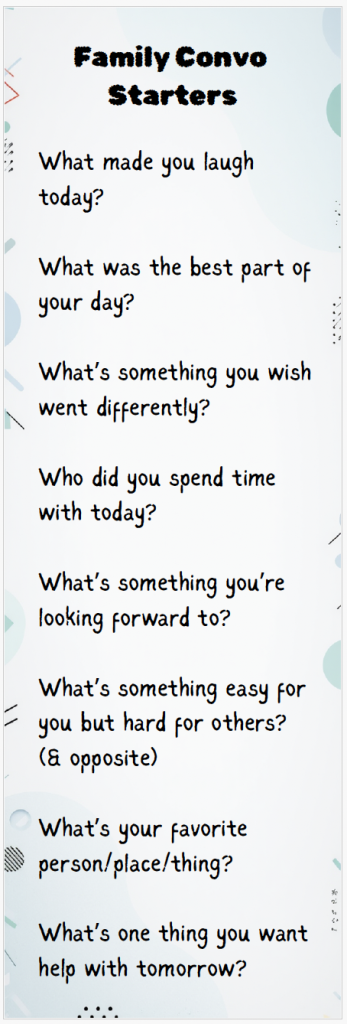
When screens are turned off, conversation gets easier if the first words out aren’t awkward. Keep a list of simple questions at the table. (See conversation guide at the end of this article)
My family keeps a deck of Brain Quest Smart Cards on our kitchen table — an age-appropriate Q&A card game with different decks for ages 2-12 that’s fun for them and stops the “so, how was your day” conversation killer. ($12 on Amazon)
3. Coloring Placemats or Tablecloths
Make dinner a hands-on place for creativity, use ChatGPT to create personalized printable illustrations, buy in bulk online or snag a Coloring Roll from Target ($5 Mondo Llama brand).
4. Screentime Together
If you can’t beat ‘em, join ‘em… without your phone.
- YouTube “Word on Beat Challenge” or kids’ karaoke
- AirPlay a slideshow of family photos on the TV
- Family movie night, their choice
You don’t need earth-shattering dialogue every night. What counts is simply being attentive when they talk.
When we do that, we’re giving them something no screen, no matter how educational or entertaining, can replicate… that they matter more than whatever popped up in our notifications.